
Kuwait and Qatar Restore Hormuz Crude Shipments to 70% of Pre-War Levels
Market Snapshot
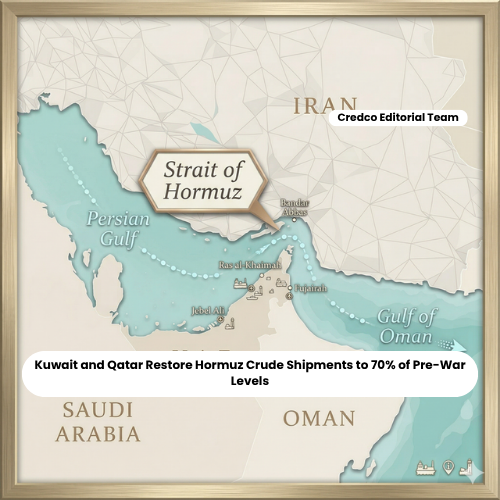
Kuwait and Qatar have recovered their combined crude exports through the Strait of Hormuz to approximately 70% of pre-war levels. The recovery has been supported by specialized shuttle operations, in which oil is transported through the contested waterway before being transferred between vessels in the Gulf of Oman. This approach has helped maintain global supply and reduce pressure on international oil markets.
Data Snapshot
Kuwait and Qatar’s combined crude exports have recovered to around 70% of their pre-war baseline.
Their combined pre-war crude export baseline was approximately 2 million barrels per day.
Daily crude flows exiting the Strait of Hormuz increased to 7-8 million barrels per day in August, compared with around 4 million barrels per day in mid-July.
What Has Changed
In mid-July 2026, crude flows exiting the Strait of Hormuz had fallen sharply to around 4 million barrels per day.
By late August 2026, daily flows had nearly doubled to 7-8 million barrels per day, supported by the increased use of shuttle tanker operations to work around the restrictions.
Key Takeaways
Kuwait and Qatar are using ship-to-ship shuttle tanker operations in the Gulf of Oman to reduce the direct exposure of conventional commercial fleets to the conflict zone.
The recovery has lifted Kuwaiti and Qatari crude flows to roughly 70% of their combined pre-war export capacity of 2 million barrels per day.
Global energy prices have eased, with Brent crude trading around $86-89/bbl, compared with previous highs of $120/bbl during the height of the blockade.
Exporters are relying heavily on their own fleets, with some vessels reportedly operating with satellite-tracking transponders switched off while navigating the high-risk corridor.
The use of shuttle operations highlights the ability of West Asian energy producers to adapt their logistics under severe geopolitical pressure. Ship-to-ship transfers in the Gulf of Oman have created a two-tier logistics system that avoids direct passage through the active conflict corridor while maintaining supplies to major Asian import markets, including India.
Market Implications
The substantial recovery in seaborne crude supplies is a major stabilizing factor for global oil markets and reduces the immediate threat of a severe supply shock.
However, these operations remain highly risky and vulnerable to military disruption. As a result, a risk premium is likely to remain embedded in crude prices, keeping Brent structurally above pre-conflict averages.
Trading Signals
Market Bias: Neutral
The recovery in daily crude flows to 7-8 million barrels per day has helped keep Brent within the $86-89/bbl range by balancing ongoing security risks and limiting immediate upward price pressure.
Overweight: Aviation, Paint Manufacturers, Oil Marketing Companies, Logistics
Underweight: Oil Exploration & Production
Trigger Factors:
Progress in diplomatic discussions over a joint navigation corridor through the Strait of Hormuz.
The impact of Iran’s newly intensified vessel-blacklisting policy on shuttle operations.
A Brent breakout below the $85 support level or above the $90 resistance level.
Time Horizon: Near term (0-3 months)
Industry Context
The Strait of Hormuz remains the world’s most important maritime oil corridor, historically carrying around 20% of global petroleum shipments. Following the escalation of the US-Iran conflict on February 28, 2026, traffic through the waterway collapsed to near-zero levels, triggering significant concerns over global oil supplies.
The successful expansion of alternative shipping arrangements represents a shift from a complete blockade toward a managed but high-risk trade corridor.
Key Risks to Watch
Iran’s newly announced blacklist targeting active shuttle tankers could disrupt ship-to-ship operations if international buyers refuse to use the affected vessels.
The risk of physical attacks remains high, highlighted by the strike on a Kuwait Petroleum Corp. supertanker in early August 2026.
Further escalation in direct military confrontations could result in a complete closure of the corridor and undermine the fragile shuttle system.
Recent Developments
Iran blacklisted 12 Very Large Crude Carriers (VLCCs) involved in ship-to-ship shuttle operations in late August, exposing the vessels to potential fines and detention.
Earlier in August, a Kuwait Petroleum Corp. supertanker was struck while passing through the Strait of Hormuz. Meanwhile, Qatari Prime Minister Sheikh Mohammed bin Abdulrahman Al Thani planned a diplomatic visit to Tehran to discuss navigation controls.
Stay ahead of market trends with the Credco app. For any queries, please reach out via WhatsApp at +91 8448083211.
Related on the Wire
- Crude·Monday, 7 September 2026
Oil Prices Rise Further as US-Iran Tensions Disrupt Hormuz Shipping
Oil prices continued to climb at the start of the week as renewed US-Iran attacks on vessels around the Strait of Hormuz intensified concerns over prolonged disruptions to Middle Eastern crude supplies. The latest developments came after OPEC+ kept its October production polic…
Read story - Crude·Monday, 5 October 2026
Oil Prices Ease as G7 Reserve Release and Mideast Supply Recovery Reduce Pressure
Oil prices extended their decline on Monday as the G7’s coordinated emergency stock release and a recovery in Middle Eastern crude exports eased concerns over supply disruptions linked to the US-Israeli war with Iran. However, Brent crude remained above the key $100/bbl level …
Read story - Crude·Saturday, 5 September 2026
Brent Climbs Past $95 as Fresh US-Iran Tensions Raise Supply Concerns
Oil prices moved back above the $95/bbl level in early September as renewed military clashes between the US and Iran brought Middle Eastern supply risks and Strait of Hormuz shipping disruptions back into focus. Falling inventories and threats to regional energy infrastructure…
Read story - Supply·Friday, 9 October 2026
European PVC Producers Push for October Increases as Buyers Resist Higher Offers
European PVC producers are entering October with plans to raise prices after the softer market conditions seen in September. Higher feedstock and energy costs are driving sellers to seek better margins, but sluggish consumption and sufficient material availability are limiting…
Read story