
Global Freight Market Update – April 20, 2026
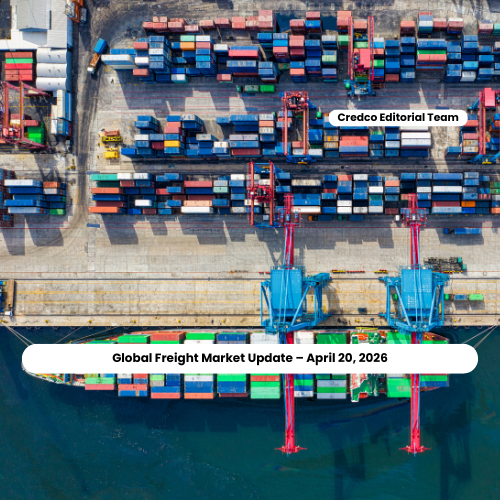
The global container index climbed to around $1,899 per 40-foot container, marking a modest 1% weekly increase. This follows a stronger rise in the previous week, indicating that while the market remains firm, upward momentum is beginning to stabilize.
Geopolitical Tensions Continue to Influence Freight
Freight markets remain heavily influenced by ongoing disruptions linked to the Gulf region. Hopes for smoother shipping through key oil routes faded again after recent security incidents, including attacks near Oman and a vessel seizure. As a result, most shipping operators continue to avoid regular operations in the region, relying only on limited and tightly managed transits.
Instead of direct route closures, the biggest impact on freight rates is coming from rising fuel costs and supply uncertainty. Higher bunker prices and limited fuel availability in parts of Asia are keeping freight rates elevated. Shipping lines have responded by introducing additional surcharges, including fuel and peak season fees across major trade routes.
Market Conditions Remain Uncertain
While major east-west shipping routes remain operational, pricing trends are becoming more selective due to weak seasonal demand. The extreme volatility seen in recent weeks has eased slightly, but uncertainty around shipping conditions, fuel costs, and geopolitical risks continues to prevent a full market normalization.
Route Performance Overview
Freight rates showed mixed movement across key global routes, with stronger gains on Pacific lanes and declines on some Suez and Atlantic backhaul routes.
Freight Rates (USD per 40ft Container)
Pacific Routes
China/East Asia → North America West Coast: $2,653 (▲ 7%)
North America West Coast → China/East Asia: $483 (▲ 10%)
China/East Asia → North America East Coast: $3,810 (▲ 4%)
North America East Coast → China/East Asia: $547 (▲ 4%)
Suez Routes
China/East Asia → North Europe: $2,743 (▼ 3%)
North Europe → China/East Asia: $442 (– no change)
China/East Asia → Mediterranean: $3,637 (▼ 5%)
Mediterranean → China/East Asia: $783 (▲ 3%)
Atlantic Routes
North America East Coast → North Europe: $535 (▼ 11%)
North Europe → North America East Coast: $2,263 (▲ 7%)
Europe → South America East Coast: $1,169 (▲ 3%)
Europe → South America West Coast: $2,792 (▲ 5%)
Outlook
Freight markets are expected to remain firm but volatile in the near term. Rising energy costs, geopolitical uncertainty, and cautious demand are likely to keep rates elevated, though further gains may be limited unless supply conditions tighten further.
Stay ahead of market trends with the Credco app. For any queries, please reach out via WhatsApp at +91 8448083211.
Related on the Wire
- Supply·Tuesday, 13 October 2026
Polypropylene Prices Surge in GCC Amid Limited Supply and Rising Freight Costs
Polypropylene (PP) prices in the Gulf Cooperation Council (GCC) region have experienced a significant surge. The increase is attributed to limited availability of the material and elevated freight costs, as reported by Polymerupdate. The geopolitical tensions, particularly the…
Read story - Polymer·Monday, 12 October 2026
Rajasthan Polymer Market Snapshot: October 10, 2026
The Rajasthan polymer market, as of October 10, 2026, is witnessing significant price movements across various polymer categories. While detailed pricing, demand, and supply information remain restricted to subscribers, it is evident that key polymers such as HDPE, LDPE, LLDPE…
Read story - Markets·Thursday, 8 October 2026
Indian Open Markets Price Table – October 07, 2026
The Indian Open Markets Price Table for October 7, 2026, provides a reference for the current state of the polymer market in India. While the bulletin is accessible, specific details regarding offers, demand, and availability remain restricted to logged-in users. The bulletin …
Read story - Markets·Wednesday, 7 October 2026
Global Chemical Prices Experience Volatility and Divergence
Global chemical prices are currently experiencing significant volatility and divergence as of mid-September. This is largely attributed to strong fluctuations in crude oil prices, regional supply-demand mismatches, and shifting downstream purchasing patterns. While certain bas…
Read story